
"Will this help my child deal with bullies?" It's one of the most common reasons parents give us for booking a trial class. The honest answer is yes, taekwondo helps. But the most important thing it teaches isn't how to hit back.
Most Bullying Isn't a Fight
A lot of bullying is verbal, social, or online: name-calling, being left out, rumors, group chats. No kick answers any of that. What protects a child in those situations is how they carry themselves, how they respond under pressure, and knowing when and how to get help. That's where taekwondo does its best work.
What Taekwondo Builds That Actually Helps
- Confidence you can see. Upright posture, eye contact, a steady voice. Kids who carry themselves with confidence are often less likely to be seen as easy targets.
- Calm under pressure. Controlled, supervised sparring teaches kids to stay composed while someone is coming at them — a skill that transfers to tense moments at school.
- A voice they know how to use. Kids practice the kihap (taekwondo's sharp yell) and answering the coach clearly in every class. That's rehearsal for a firm "Stop. Leave me alone."
- Restraint. Control is the first lesson on our mat: respect your partner, and never use what you learn outside class except to protect yourself.
- Physical skills as a last resort. Self-defense is part of our belt syllabus alongside kicks, blocks, and forms. The goal is to get free, get distance, and get to an adult — not to win a fight.
The Order Every Child Should Know
When a child feels threatened, this is the order of responses we'd want them to reach for:
- Walk away and put distance between you and the other person.
- Use your voice — loud and firm: "Stop. Leave me alone."
- Tell a trusted adult — a teacher, guard, or parent. Telling isn't tattling.
- Defend yourself physically only if you can't get away and you're in danger — then get away and tell an adult straight after.
What the Research Says
There's growing evidence behind this. A 2017 meta-analysis of child and youth studies found that martial arts training was associated with reduced aggression (Reducing aggression with martial arts) — the opposite of what some parents worry about. And a randomised controlled trial of a martial arts–based program, designed as an alternative to traditional anti-bullying approaches, found improvements in resilience and self-efficacy among the 283 secondary students who took part (Developing Wellbeing Through a Randomised Controlled Trial of a Martial Arts Based Intervention).
What Taekwondo Can't Do
We'd be doing you a disservice if we oversold this:
- It won't stop cyberbullying or social exclusion on its own.
- It doesn't replace the school's role. If your child is being bullied, talk to their teacher or school administration.
- Be wary of any program that promises to make your child "bully-proof" — that includes us.
- If bullying is affecting your child's mood, sleep, or willingness to go to school, consider speaking with a counselor.
Is Sparring Safe?
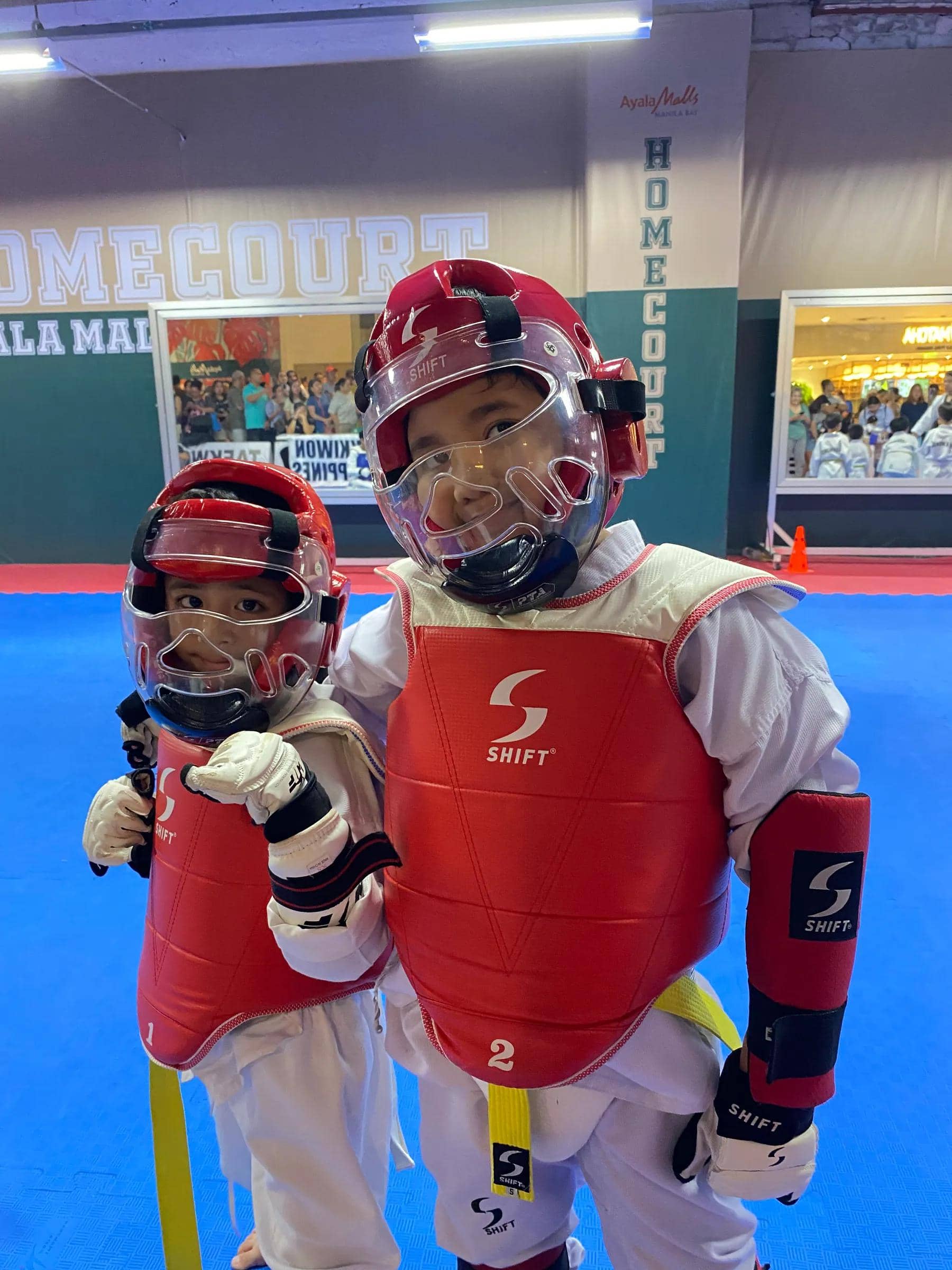
Sparring at Grit & Glory is introduced gradually: newer students work on forms, pad work, and controlled drills long before any live sparring, which is always supervised, light-contact, and matched to rank. Little Tigers, Junior Warriors, and Teens & Adults never do contact drills together. Our guide to whether taekwondo is safe for kids covers the injury data in detail.
Getting Started
Classes are split by age — Little Tigers (3–6), Junior Warriors (7–12), and Teens & Adults (13+) — at all three branches in Taguig and Parañaque. The first class is free and you're welcome to watch. Book a free trial class.
Common Questions
Will taekwondo teach my child to fight back?
It teaches real self-defense skills, but the emphasis is on confidence, control, and getting to safety. Physical defense is a last resort.
Will taekwondo make my child more aggressive?
The evidence points the other way: a 2017 meta-analysis found martial arts training was associated with reduced aggression in children and youth, and restraint is taught from the very first class.
Is self-defense part of the regular curriculum?
Yes. Self-defense techniques are part of the belt syllabus, alongside kicks, blocks, stances, and forms.
What should I do first if my child is being bullied?
Talk to your child's school. Taekwondo can build confidence alongside that, but it isn't a replacement for involving the school.